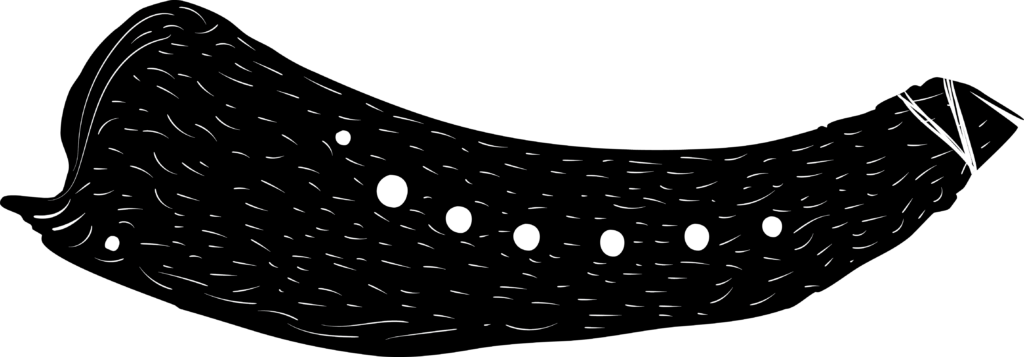
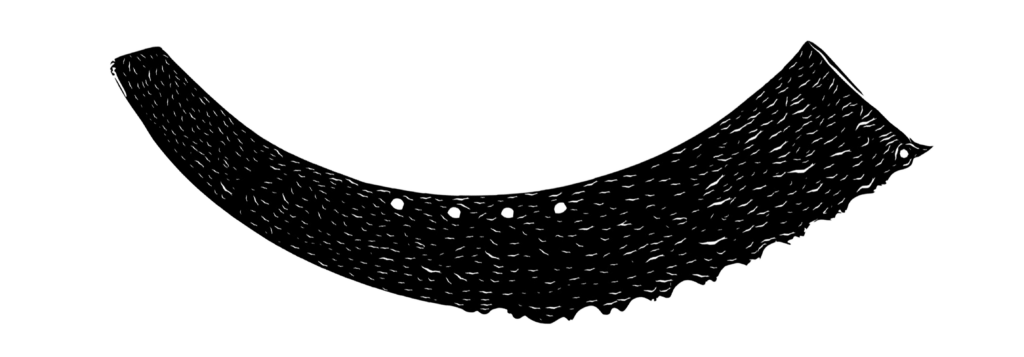
The Meråker clarinet is a type of folk clarinet that was used especially in Meråker in Trøndelag, and is probably the only clarinet that has survived to the present day. Locally, the instrument was originally called a «flute», even though it resembles a simple clarinet more than a flute. The instrument belongs to a small and fragmented family of shepherd's clarinets that have been in use in Norway: the Volla clarinet from Oppdal and the Østerdal clarinet that turned up at the Glomdal Museum in Elverum. In addition, we have written records of three other shepherd's clarinet in Trøndelag, at Inderøya, Levanger and Røros.

History
The traditional Meråker clarinet was made by taking two hollowed-out halves of wood that were fastened together and placed in water until they swelled. This approach is very similar to the making of wooden lurs, which points to a relationship between these instruments. Then the end was trimmed, a small plug attached, and a wooden splinter of juniper was tied to the blowing end – similar to a flishorn. Finally, eight finger holes and one thumb hole were cut or drilled out. The construction bears a clear resemblance to other popular clarinet-like instruments in the Nordic countries, such as the Finnish «mänkeri».
The Meråker clarinet was first and foremost a shepherd's instrument that was made and played by shepherds and young people in Stordalen. In the first decades of the 20th century, the instrument fell out of use, which was linked to the fact that traditional mountain pasture farming was in decline. As with many other traditional instruments, there was a risk that the knowledge of how to make and play the Meråker clarinet would disappear completely.
In the mid-1950s, workers at the smelter in Kopperå had the idea that they should take up the tradition of making these shepherd's clarinets. Harald Gilland (1912-1992), who had learnt how to make clarinets from his father in his youth, and who was also a skilled fiddler, set to work. This was the start of a new era for the Meråker clarinet.
Østerdalsklarinetten (The Østerdal Clarinet)
At the Glomdals Museum in Elverum, there is a closely related instrument to the Meråker clarinet that is often referred to as the Østerdal clarinet. The museum has no background information about the instrument beyond its being registered as a «flute», probably in 1912. The origin is uncertain – the instrument may come from Østerdalen, but also from the Solør/Finnskogen area. It is about 50 cm long and consists of two split halves that are hollowed out and lashed together again with birch bark. A mouthpiece is shaped at one end, and at the other end there is a bevelled mouthpiece with traces of lashing with thread, probably for fastening a reed. On the upper side the instrument has seven finger holes of roughly the same size, placed at roughly equal spacing.
The renaissance man Gilland
Gilland gradually changed the way the clarinet was made and adapted the instrument to more modern times. The modernised Meråker clarinet was turned from a single piece of wood, preferably hard birch. The instrument was then given a flat reed bed, varnished with plastic lacquer and fitted with a clarinet reed that he had thinned out beforehand. Gilland experimented with Bb clarinet reeds at first, but settled on Eb clarinet reeds as the best fit. The reed was attached to the mouthpiece using a copper wire or hose clamps.
Gilland mainly made his clarinets in two different lengths, with A and Bb as the fundamental tone, but also made a few clarinets tuned in G. The number of finger holes was still eight on the top and one thumb hole on the bottom. This modernised version of the Meråker clarinet made it easier to play with other instruments and made it more versatile.

In the early 1970s, Gilland formed a trio with the fiddler Svend Gravåsen and the guitarist Olaf Tideman. At the same time, he transferred many of his old fiddle tunes from the village of Stordalen to the clarinet, including several springar dances.
After Harald Gilland died in 1992, the building of Meråker clarinets in the village was continued by Nils Underhaug, who learnt the art directly from Gilland. In addition, instrument maker Magnar Storbækken (1956-2022) at Tolga in Nord-Østerdal developed his own version of the Meråker clarinet.
In recent years, the Meråker clarinet has found its place as a valuable element in the Norwegian folk music tradition. The instrument represents a unique fusion of different instrumental traditions: it has features from the lur, the flishorn and other shepherd's clarinets. At the same time, the modernisation of the instrument has made it possible to include it in a wider range of musical contexts.
Repertoire
The repertoire on the Meråker clarinet belongs in a very special fiddler's environment in Stordalen, where mining, farming and good contact across the border with Jämtland meant that both people and music were continuously on the move. The fiddle was played a lot, but there were also several clarinet players who used both bought and home-made clarinets - Jo Teveldal (John Torsteinsen Stordalsvold, 1826-1913) and Jo Gilset (Johan Severin Gilset, b. 1887) are mentioned in particular.
The most important music heritage in Stordalen is that of Johannes J. Brekken (1858-1931). the "Steiger" at the Lillefjell mines – and onwards through Hans Gilland and Olaf Bjørneggen, before ending up with Harald Gilland and Svend Gravåsen. Harald Gilland transferred many of these old tunes to the Meråker clarinet, and that is much of the reason why we can speak of a Meråker clarinet repertoire at all today.
An important divide in the village was springar dance versus pols. Springar was the name of the older, local music (and dance), while pols came in later - and after WW II the springar gradually disappeared as a dance form. A lot of things disappeared, but the music that also functioned as pols dance lived on and slipped into the newer pols repertoire.
Among the oldest music pieces, we find the so-called "Steiger pieces" after Brekken, with clear links to music material in Jämtland (Sweden) and the Lapp-Nils tradition; not always identical, but close enough to hear the relationship in the twists and turns.
Finally, a little detail I like a lot: The only one of the clarinet tunes that Harald Gilland could remember his father also playing on the shepherd's clarinet is a little "hoppvals": Hoppvals etter Hans Gilland. Gilland also plays this tune at the end of this clip from Norge Rundt from 1978:
Buy a Meråker clarinet?
Are you looking for a Meråker clarinet? Place an order here:

Meråker clarinet
Handcrafted Meråker clarinet with 8+1 finger holes, adapted to Eb clarinet reeds. Built according to tradition from Meråker in Trøndelag, Norway. The clarinet is made in the key of A (traditional), G or Bb. On the G the finger holes sit further apart than on the A and Bb. Supplied with two reeds and a cap. Made to order.
Further reading:
2023 - Bjørn Aksdal – Klarinettinstrumenter i norske folkemusikk
1993 - Atle Lien Jenssen - Østerdalsklarinetten - et glemt tradisjonsinstrument?
1992 - Bjørn Aksdal – The Meråker clarinet