The herding horn of the fäbod
The cow horn is usually the smallest of the Nordic natural horns, but in Sweden it is the most common of them. There it is called herding horn, from «valla», to herd, and it holds the same position as the bukkehorn does here: the very sound of summer pasture. For hundreds of years the horn tunes rang between the fäbodar, the Swedish summer farms, blown by herders who carried the horn on their belt next to the knife and the salt bag. It was a working tool on a par with the axe and the scythe, and only secondarily a musical instrument.
What is a cow horn?
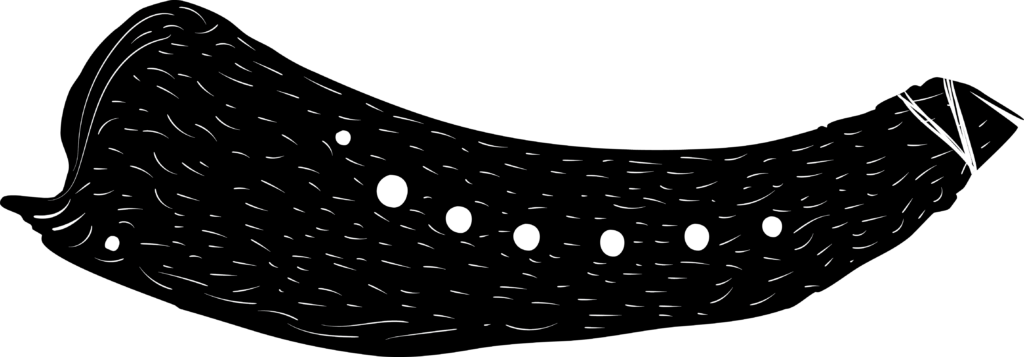
A cow horn, or kuhorn in Norwegian, is a lip-blown natural horn made from the horn of cattle. You make the tone with your lips, as on a trumpet or a bukkehorn. Since the cow horn is rounder in cross-section than the goat horn, it gets a round blowing end where the bukkehorn has traditionally had an oval one.
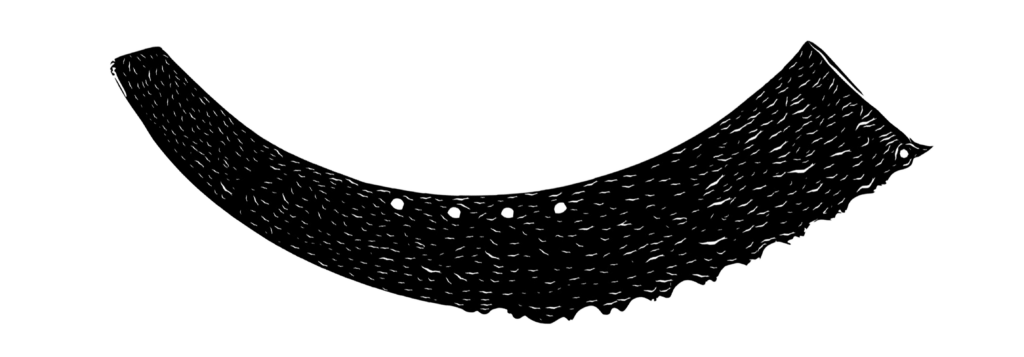
The name misleads many. The cow horn is usually smaller than the bukkehorn. The horns of Norwegian and Swedish cows are short, while a full-grown billy goat can carry horns well over half a metre long. A typical cow horn therefore has a brighter fundamental and a narrower range than the big bukkehorn. Three finger holes is the classic layout, and three or four is the norm on Swedish vallhorn (Bäckström 1984). Horns with no finger holes at all exist too, especially in northern Sweden, where scaring off predators was the main job. Such horns were called tjuthorn or tuthorn, pure signal and scaring horns (Larsen 1979).
From the Iron Age to the fäbod culture
The cattle horn has deep roots in Scandinavia. Vallhorn have been found from the late Iron Age, and the bronze lurs, some 2,500–3,000 years old, were in all likelihood modelled on the animal horn itself (Bäckström 1984). One of the oldest dated Swedish horns was found in the Sandbacksmyren bog near Västerby in Hedemora in 1936, and pollen analysis dates it to the 10th century. It has four finger holes and a decorative band along the bell, so melodies were already being played on cow horns in the Viking Age, not just signals.

The Norwegian and the Swedish tradition
The distribution of horn types in Scandinavia is almost mirrored across the mountain border. Leif Løchen puts it bluntly: of the playing horns preserved in Norway, practically all are made from goat horn, and he knew of only two Norwegian cases where cow horn had been used. In Sweden it is the exact opposite, with few goat horns and a large majority of cow horns (Løchen 2000). Aksdal's more recent material nuances the picture a little for Norway. Cow horns are found mainly in Hedmarken and Nord-Trøndelag (Aksdal 2023). From Furnes in Hedmarken there is even a preserved cow horn with a flute mouthpiece, cut like a fipple flute (Jenssen 1994). And in use, the cow horn was well known here too. From Sunnmøre, Nupen tells that cow horns and bukkehorn announced the meals from the farmyard: dinner, afternoon meal and supper. The horn was «the telephone of our day» (Nupen 1999).
The flishorn goes the opposite way. The horn with a fitted juniper reed, which has a strong tradition in the Norwegian valleys, was known in Sweden only from the border areas: Jämtland, Värmland and the village of Rörbäcksnäs in western Dalarna. Holger Larsen documented the tradition there in the 1970s, and Per Anton Moberg in Rörbäcksnäs was the last Swede to keep it alive (Larsen 1977; Bäckström 1984). Read more about that horn type in the article on the the flishorn.
Roland's horn from 1656
The oldest dated playing horn we have in Norway is not a bukkehorn but a cattle horn. The Norwegian Museum of Cultural History acquired it more than a hundred years ago, with the information that it came from Nord-Fron in Gudbrandsdalen. The horn is only 23 cm long, has three finger holes and is richly decorated with carved bands. In rings around the horn is scratched: «ROLANDS HORN + ESUS + NAFN. ANNO 1656 MID ANE NIELSDATTER», that is, dated 1656 and marked with a woman's name (Sevåg 1973, p. 36). Sevåg reads the horn as an ox horn, Løchen as a cow horn; a cattle horn it is in any case. Today it is on deposit at Ringve Music Museum in Trondheim.

A working tool like the axe and the scythe
For the people of the fäbod, the horn was something you had to master to do your job, and the young girls started learning to blow early, before they went out herding themselves (Bäckström 1984). The horn had three main tasks. The first was calling. Together with calling cries and kulning, the horn kept the herd together and led it along fixed paths through the forest. The calling tunes could even distinguish between cows, sheep and goats. Richard Dybeck, who collected and printed herding tunes in the mid-1800s, wrote that even the cattle seemed to tell the tunes apart. The second was messages. Specific signals told that a cow was missing, that one had been found, or simply that all was well. Hearing the horn of the neighbouring herding girl through the forest was knowing you were not alone. The third was scaring off predators. In folk belief, the animals told the instruments apart, as the wolf himself is allowed to say in a verse from Hälsingland:
Blisterpipor och fingerhorn
låta mig väl uti öra,
tjutlurar och tjuthorn
köra mig långt bort i myra.
The melody instruments attracted the predators, in other words, while the lur and the tjuthorn drove them away. And long after herding came to an end, the horn kept one annual function. At WalpurgisCatholic feast day on 1 May. In Sweden celebrated with bonfires the evening before, Walpurgis Night., when the animals were let out after the winter, people lit fires and blew horns and lurs to scare away bears, wolves and evil powers.
The vallkullor who carried the tradition
Work at the fäbod was women's work. It was the herding girls, vallkullor in Swedish, who carried the horn, and so it became first and foremost a women's instrument. That is worth noting, because elsewhere in folk music it is men who dominate the sources. And the female line is old: a Swedish manuscript from the late 1400s has a separate word for a female horn blower, «hornblasirska», alongside the usual «hornblåsare» (Larsen 1979).
Tillmans Sara (1846–1935) from Nås in Dalarna said of her herding tune that «den bruk je späla då je tapp bort nå krittur», she played it when she had lost some cattle. Then the neighbours understood and came to help. The first tune of the day on her horn was often a hymn, and when the working day was over she blew a song. Ris Kersti (1858–1938) from the Rättvik area learned horn playing from her mother while herding, won first prize in Mora in 1908 and blew the opening of the national fiddlers' gathering in Stockholm in 1910, inside the rooms of the Royal Swedish Academy of Music. It was probably the first time a horn tune had sounded in that house. And when Anders Zorn announced the fiddlers' competition at Gesunda in 1906, the one we remember today as the start of the Swedish spelmansstämma gatherings, it was the horn blowing that took centre stage, not the fiddle (Bäckström 1984).
The Swedish tuning system
Swedish horn makers tune their horns in the minor mode, and the system differs from what has become standard on Norwegian bukkehorn (Bäckström 1984). On a cow horn with three finger holes, the resonant tone, the tone you get with all the holes covered, is not the tonic of the scale but the second degree. The tonic lies a whole tone below, and you bring it out with the stopping technique: cover all the finger holes with one hand and put the other some way into the bell, and the tone sinks. With the hand even further in, you also reach tones below the tonic. A horn with four finger holes, on the other hand, gives the tonic directly with all holes covered. In both cases the scale is the same, a pure minor pentachord: tonic, whole tone, semitone, whole tone, whole tone. Good horns can also be overblown to the octave of the tonic, and the semitones in between are found with fork fingerings or by half-covering holes.
On the modern Norwegian bukkehorn it is the reverse. There the resonant tone is the tonic itself, and the free hand in the bell makes the leading tone below. Same technique, two systems. Once you know which one your horn follows, you find the scale at once.
How cow horns are made
The method is essentially the same as for the bukkehorn. The raw horn should be at least 15 cm long. Shorter horns come out bright and hard to get a tone from; longer horns give a darker sound and an easier embouchure. I boil the horn for an hour or so, until the core, the bone cone inside, loosens and can be knocked out. Then I cut the tip. I do not simply cut where the diameter suits the mouth, about 2 cm for a cow horn, but 1–2 cm beyond the point where the natural cavity ends, and I drill a 6–8 mm channel from the tip into the cavity, angled to follow the curve of the horn.
The mouthpiece on the old horns is almost always wide and drilled straight, with no cup or funnel of the kind modern brass instruments have, and it works at least as well (Bäckström 1984). I drill the finger holes small and widen them during tuning, because it is the size of the hole more than its position that decides the pitch. Finally comes the polishing and, often, some scratched decoration. On the old horns you find initials such as BED for Britta Eriksdotter, finely cut with a knife.

Where the horn carries best
The horn tune is made to carry far, and the old horn blowers knew where the sound went. Not from the mountain top, as you might imagine; from there the horn carries poorly, and it does not ring either. Rather some way down the hillside or on the valley floor, where the surrounding ridges throw the sound back. A pine heath gives a fine, open resonance without echo, still water carries the sound far, and damp weather helps too (Bäckström 1984). «Hä skä låt långli», said the fiddler Köpman Erik in Gagnef about the horn tunes; it should sound long. That is why the herding tunes are built from long, continuous lines where the notes are allowed to ring out, more like a call than a march. The horn is an extension of the voice.
The cow horn today
The Swedish tradition came close to dying out in the 20th century, but was saved by a few enthusiasts. Carl Gustaf Färje (1917–1976) tracked down tunes and tradition bearers and published the collection Fäbodlåtar från Dalarna with more than 200 herding tunes, and in 1973 he took the initiative for the first horn blowers' gathering in Mora, an annual tradition ever since (Bäckström 1984). Today the vallhorn lives on at fiddlers' gatherings and fäbod days, in concerts and among a growing number of people who simply want to bring the horn along on a walk.
Here in Norway the cow horn has always stood in the shadow of the bukkehorn, but it deserves its place. It is the cheapest of the natural horns to find raw material for, it sits well in the hand, and the bright, open sound carries surprisingly far. For anyone who wants to start with natural horns, it is a good place to begin.
See also the close relatives: bukkehorn, flishorn and lur.
Frequently asked questions about the cow horn
What is a cow horn?
A cow horn is a lip-blown natural horn made from cattle horn, where the tone is produced with the lips, as on a trumpet. In Swedish it is called vallhorn, and it is the most common herding horn in Swedish tradition. Most cow horns have three or four finger holes.
What is the difference between a cow horn and a bukkehorn?
The material and the size. The cow horn is made from cattle horn and is usually smaller than the bukkehorn, with a round blowing end and a brighter fundamental. The bukkehorn is made from goat horn, is flatter in cross-section and gives an oval blowing end. The playing technique is the same.
Is the cow horn bigger than the bukkehorn?
No, it is usually the other way round, despite the name. Norwegian and Swedish cows have short horns, while a full-grown billy goat can carry horns of more than half a metre. That is why the cow horn tends to have a brighter tone and a slightly narrower range.
Why is it called vallhorn?
Vallhorn is the Swedish name, from the verb «valla», to herd livestock. Strictly speaking it is a collective name for all herding horns, goat as well as cattle, but the great majority of Swedish vallhorn are made from cattle horn. The herding girls who carried the horn were called vallkullor. In Norwegian, lokkehorn (calling horn) has been used for the same thing.
How is a cow horn tuned?
In the minor mode, following Swedish tradition. On a horn with three finger holes, the resonant tone is the second degree of the scale, and you bring out the tonic a whole tone below by putting your free hand into the bell, the so-called stopping technique. A horn with four finger holes gives the tonic directly.
What does a cow horn sound like?
Warm, open and trumpet-like, with rich overtones, softer than the sharp flishorn. In good conditions the sound carries for several kilometres, and every horn has its own fundamental and character, since no two horns are alike.

Buy a cow horn?
I make cow horns to order in my workshop, lip-blown, of the Swedish type, and no two horns turn out alike.
Sources:
1846 - Richard Dybeck - Svenska vallvisor och hornlåtar (cited from Bäckström)
1973 - Reidar Sevåg - Det gjallar og det læt: frå skremme- og lokkereiskapar til folkelege blåseinstrument (Det Norske Samlaget)
1977 - Holger Larsen - «Bockhorn med påslående trätunga. En anmälan», Svensk tidskrift för musikforskning 1977:2, pp. 71–78
1979 - Holger Larsen - «Vallhornet i Sverige», Svensk tidskrift för musikforskning 1979:2
1984 - Magnus Bäckström - Hornet – skogens instrument (Dalarnas museums serie av småskrifter 41, Falun)
1994 - Atle Lien Jenssen - Bukkehorntradisjon på Hedmarken
1999 - Dagfinn Nupen - Eldre folkemusikkinstrument: læring på gamlemåten (Ørsta)
2000 - Leif Løchen - Fra skorofele til salmodikon: artikler og innlegg i aviser (Nord-Gudbrandsdal folkemusikkarkiv), pp. 76–77
2023 - Bjørn Aksdal - «Bukkehornet – en gjennomgang og analyse av trompethorn og tungehorn», Musikk og Tradisjon no. 37